
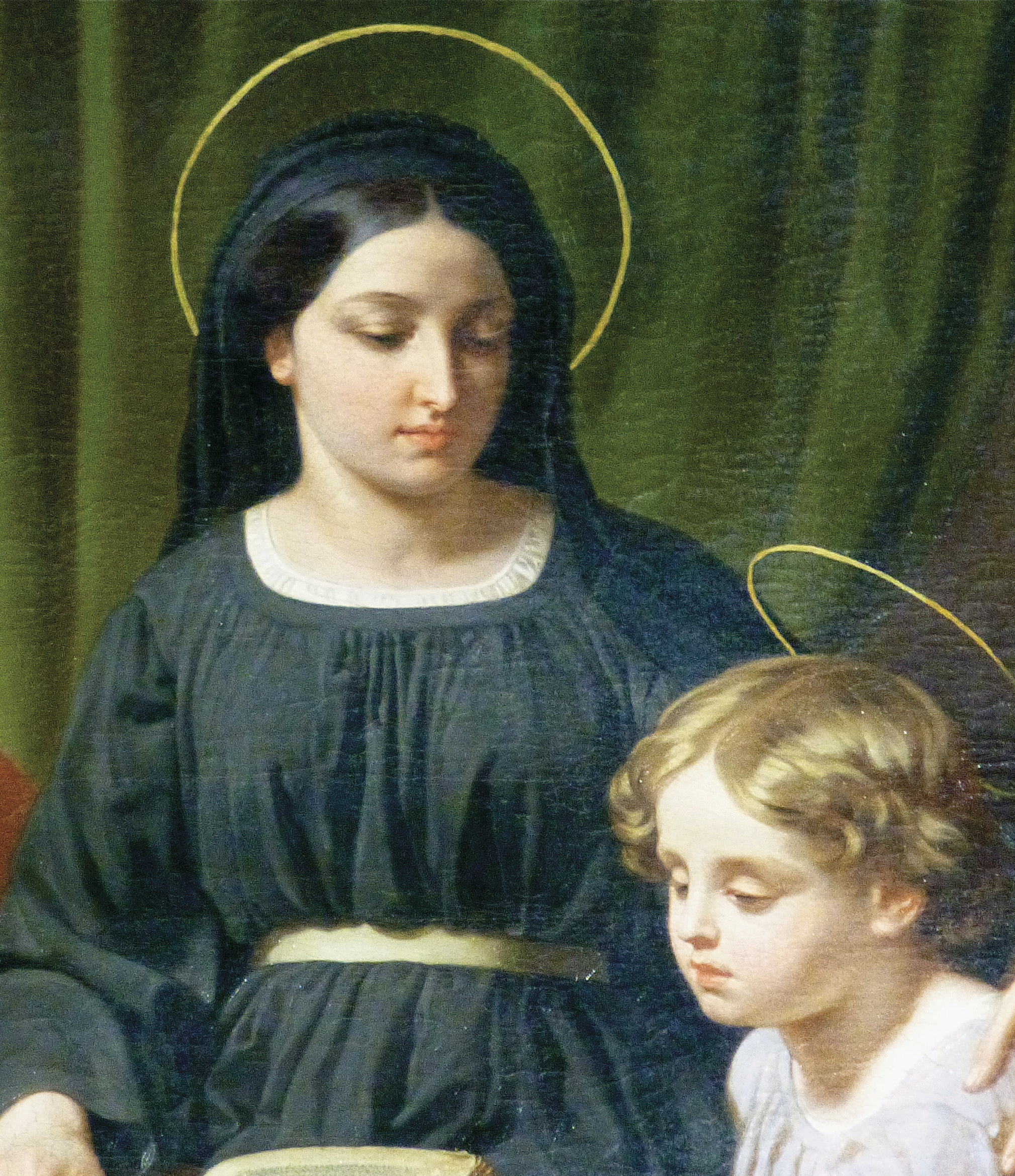
Saint Marcellina.
Saint Marcellina was born in Rome about 327. She was the older sister of Saint Ambrose of Milan and Saint Satyrus.
She left Trier, where her father resided as prefect of Gaul. After her father’s death she went to Rome. Once there, Marcellina was entrusted by her pious mother with the education of her brothers, whom she inspired by word and example to thirst for Christian virtue.
She received the veil of a consecrated virgin from the hands of Pope Liberius on Christmas Day, 353, in Saint Peter's Basilica. During his homily on that occasion he exhorted her to embrace the evangelical virtues and to behave in church with the utmost respect. The advice, which the pope addressed to her on this occasion, has been preserved by St. Ambrose (De virginibus, III), which emphasized especially the obligations of christian virgins to preserve virginal purity.
After Ambrose became Bishop of Milan (374), Marcellina and her brother Satyrus went to live with him in Milan. She lived a life of great austerity, which St. Ambrose tried to persuade her to mitigate.
Ambrose fell sick and died on April 4, 397; Marcellina survived her brother and died in 398 or shortly afterwards.
She also was buried in the crypt under the altar of the Ambrosian Basilica, and was honoured as a saint. Her feast is celebrated on 17 July.

Saint Ambrogio
Bishop of Milan and Doctor of the Church, Ambrose was born about 340 at Trier (modern Germany), of christian parents.
Educated in Rome, he became (c.372) governor of Liguria and Aemilia with the capital at Milan. He was highly regarded as governor and popular pressure resulted in his appointment (374) as bishop, although he was reluctant and lacked religious training.
After much study, he became the chief catholic opponent of Arianism in the West. He was adviser to Emperor Gratian whom he persuaded to outlaw (379) all heresy in the West. He firmly refused the demands of Justina and the young Emperor Valentinian II to surrender a church of his diocese to the Arians. “The Emperor,” he preached, “is in the Church, not above it.”
He excommunicated Theodosius I for the massacre at Salonica (390) and imposed a heavy public penance on him before reinstating him.

Saint Satyrus
Nacque a Treviri nel 337.
Satyrus was born in Trier in 337.
After the untimely death of his father, Satyrus went to Rome with his family. He was then eighteen years old and attending the rhetoric school in order to become a lawyer.
In 363, having completed his literary and legal studies, he enrolled, despite the persecutions inflicted on the Christians by the emperor Julian, in the role of lawyers. After leaving Rome for the necessary training in the province, Satyrus began his travels in the provinces of the Empire, until the election of Ambrose as bishop, who summoned him to Milan with his sister Marcellina. Here, sacrificing his career, he put himself at the disposal of his brother bishop, becoming a wise and generous administrator of ecclesiastical substances, a kind of lay deacon devoted to helping the most needy.
Returning from a perilous journey to Africa,where he had gone for the sake of justice and the poor. He was shipwrecked and was forced to stop in Rome, seriously ill. It was during this terrible journey back that Satyrus received baptism and the Eucharist. Eager then to rejoin his brothers, he died piously in Milan assisted by Marcellina and Ambrose, on 17 September in the year 379.

Blessed Maria Anna Sala
Daughter of Giovanni and Giovannina Sala; fifth of eight children in a pious family. Maria Anna Sala was born in Brivio (Lecco- Italy) on April 21st, 1829.
She was educated in the convent school by the Sisters of Saint Marcellina in Vimercate, where she stood out for her piety, purity and zeal.
Maria Anna wanted to join the Sisters, but her family needed her help, and she returned home. In 1848, her family obligations fulfilled, she returned to the Sisters, and made her profession on 13 September 1852; for her perfect observance, she was named the “living rule”.
Over the next four decades, she taught at the Marcellina schools in Cernusco, Chambery, Genoa, and Milan. As teacher, she was totally dedicated to the young people whom she led towards God through a solid cultural and religious education.
Moved by divine love, mild, caring, maternal and with a heroic spirit of sacrifice she persevered in her holy mission until the end of her life.
Diagnosed with throat cancer in 1883, she kept the matter to herself and continued to work for another eight years. She died on 24 November 1891 in Milan, Italy of throat cancer.
Throughout the beatification investigation and recognition everyone involved stressed her quiet dignity and her unwavering devotion to Christ no matter how severe the pain or trying her circumstances.
Her Cause of beatification was introduced in 1920.
Pope John Paul II beatified Maria Anna Sala on 26 October 1980.
Memorial: 24 November.

Blessed Carlo Acutis
From the foreword by Cardinal Angelo Comastri:
“To always be close to Jesus, that’s my life plan”.With these few words Carlo Acutis, the boy who died of leukaemia, outlines the distinguishing feature of his brief existence: to live with Jesus, for Jesus, and in Jesus. (…)“I'm happy to die because I've lived my life without wasting even a minute of it doing things that wouldn't have pleased God”. Carlo also asks the same thing of us - to emulate the Gospel with our life, so that we can be a beacon lighting the way for others.
From the foreword by The Most Reverend Bishop Michelangelo M. Tiribilli:
A teenager of our time like many others, going to school and seeing his friends, and an expert for his age in computers. His encounter with Jesus Christ fitted into all of this.
Carlo Acutis is witness to the Resurrection, he places his trust in the Virgin Mary, lives a life of grace, and tells his contemporaries about his incredible experience with God.
He goes to Mass and takes Communion every day and passes hours in front of the Blessed Sacrament. His Christian development and experience bear witness to the truth in the words of Pope Benedict XVI's Apostolic Exhortation, Sacramentum Caritatis: “The Sacrifice of Mass and Eucharistic adoration corroborate, support and develop love for Jesus and willingness for ecclesiastic service”.
Carlo is also devoted to Our Lady, faithfully says his Rosary and dedicates his devotions to her as his beloved Mother.
In sociological terms this boy is the same as his school friends, and bears out the fact that the Gospel can also be experienced fully by an adolescent.
His brief existence, reaching out with the aim of encountering Jesus, was like a beacon lighting the way not only of anyone who met him on their path, but also of those people yet to know his story. I am more than confident that this first biography of Carlo Acutis by Nicola Gori, with its recognisable descriptive ability, will help today's adolescents, who have so many issues and are so heavily influenced by the mass media, to reflect on their life and evangelic values as a way of fulfilment.
By looking at this adolescent as one of them and as someone who was captivated by the the love of Christ, which enabled him to experience pure joy, these teenagers will be in contact with an experience of life that doesn't take anything away from the richness of their teenage years, but which actually makes them more valuable.
The evangelical testimony of Carlo doesn't just provide inspiration for today's adolescents, it also encourages priests and teachers to ask themselves about the validity of the teaching they provide for the teenagers in our parishes, and how to make this teaching effective and profound.